- Juli 27, 2026
- --
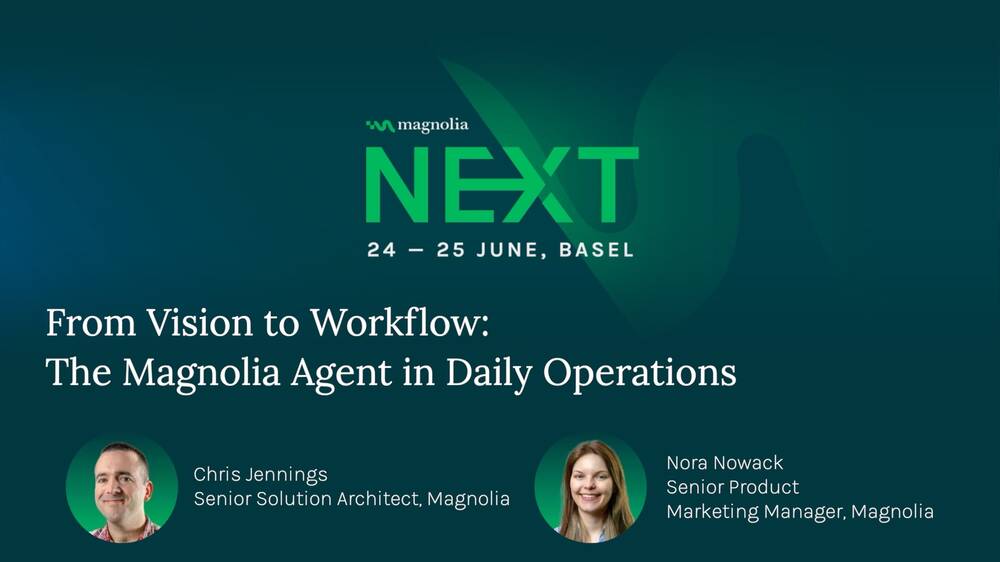
From vision to workflow: The Magnolia Agent in daily marketing operations
Key insights
-
A small team, a growing workload: more campaigns, higher quality, the same budget — the pressure most marketing teams are living with right now.
-
Detect faster: turn an outside report into a validated content gap in minutes, using semantic search against your own content instead of a morning of manual digging.
-
Create without the tab overload: doc-to-page turns a brief into a structured, on-brand page, including generated images, in one flow.
-
Localize without breaking the layout: AI translation understands page structure — headings, components, links, CTAs — not just raw text.
-
Optimize for two audiences: search engines and AI models, with SEO and GEO tooling built into the publishing flow, not a separate project.
From vision to workflow: The Magnolia Agent in daily marketing operations
A small team, a growing workload
Most marketing teams have added AI tools over the past two years without solving the actual problem underneath: the manual process behind every campaign hasn't changed. You're still opening a dozen apps, copying content between them, and hoping nothing gets lost along the way — just with an AI chatbot open in an extra tab.
The data backs this up.
According to 81%, respondents are "either piloting AI agents or have already implemented AI agent initiatives," and "half of respondents report their organizations lack the technical and data stack readiness required for AI agent deployment." Gartner press release, Gartner Survey Finds 45% of Martech Leaders Say Existing Vendor-Offered AI Agents Fail to Meet Their Expectations of Promised Business Performance, October 29, 2025.
That means, in our view, we are all sitting on massive, expensive MarTech stacks while only using the bare minimum. We need to stop adding more tools and start building a smarter foundation.
Forrester's research on agentic AI tells a similar story: most enterprise organizations are experimenting with agentic AI, but only a small share have reached meaningful production use. Many are stuck in what Forrester calls "agentic sprawl" — a growing pile of disconnected AI pilots with no orchestration behind them. (Source: The State Of Agentic AI, 2026, Forrester Research, Inc., 2026) The fix isn't another standalone tool. It's a smarter foundation that connects the steps you already take.
There's a second shift underway at the same time: how people find your brand is changing. Fewer people click through search results; more people ask an AI assistant for an answer and act on it. We go deeper on what that means for your content in The Magnolia Agent: an open framework for agentic content operations — but the short version is that your content now has to work for two audiences: people, and the AI models increasingly standing between you and them.
The Magnolia Agent is built to help with both problems at once, across four connected stages: detect, create, scale, and optimize. Here's what that actually looks like, using a fictional B2B bank we'll call Fynanz as a working example.
Detect: Turning a report into a content brief in minutes
A new analyst report on consumer banking trends lands in the shared drive. Historically, figuring out whether it points to a content gap meant reading it end to end, cross-referencing it against everything already published, and hoping nothing got missed along the way.
With the Magnolia Agent, that step looks different. Ask it directly: "What are the three key trends in this document that matter most for the banking industry?" The Agent runs a document-summarization tool against the report, sets that as its working context, and answers your specific question — not a generic summary of the whole document.
The more useful question comes next: "Of these three topics, which do we already have content about, and where's the gap?" The Agent runs context_search — powered by Magnolia's vector database — against your own content, matching on semantic meaning rather than exact text. In one real run against three banking themes, it matched two against existing articles and flagged a clear gap: nothing published yet on AI-native development for banks.
"Instead of digging through documents myself, trying to find the right report, opening the right app, I start a conversation with the agent, and in under five minutes I've identified my content gap and have a topic for a new piece."

Detect isn't limited to a single search, either. In one internal test, asking the Agent to translate a page into French and German produced something more interesting than a straight answer: it worked out on its own that its translation tool only handles one language at a time, so it needed to run it twice, without being told to.
"It can do that reasoning to figure out complex workflows. If I can explain what I want - Translate this page into French and German — the agent worked out on its own that it needed to run the tool twice. I can just explain the outcome; it figures out how."
Create: From brief to on-brand page, without the browser-tab overload
Knowing the topic is one thing. Getting it live is where campaigns usually lose momentum — a content brief in one app, the design system in another, a fifth round of edits with a designer over a hero image, and a handful of tabs open to different image generators trying to match the brand's style.
Doc-to-page removes most of that. Provide a page title, select an existing page as a layout template, and either upload the brief document or paste it directly — image descriptions included. The Agent generates the page: hero, intro, and section copy adapted from the brief, mapped onto the layout's existing structure, with generate_image rendering a unique, on-brand visual directly into the page. It reuses the same vector database from the detect stage to select the best-fitting existing assets automatically, rather than making you hunt for them.
Curious to learn more about doc-to-page?
Read the deep dive on how doc-to-page works and the magic behind it.
The page still gets a human review before anything ships. What changes is where your time goes: less of it spent assembling a blank page, more of it spent on the parts that actually need judgment.
"I was impressed that it can interpret the formatting in the document. If you've bolded a bit of text and it recognizes that it's meant to be the title. It turns your content into real components — not generic HTML you'd have to hand-edit."
On the learning curve: Everything built so far assumes you already know Magnolia DXP — the structure, how to open a page, how to navigate. Past that baseline, the honest answer is that nobody has mapped every use case yet.
"The only limit is your imagination — and the tools available today. With ten tools already, you can do a lot; it's the complex, detailed cases where you find the edges."
Scale: Translating without breaking the layout
A page that's live in one language and one market doesn't help a global campaign. The traditional path — exporting files, emailing local teams or agencies, waiting on feedback, pasting translations back into every language — can take days or weeks, and it's usually where campaign momentum stalls out completely.
The Magnolia Agent's translation tooling works differently because it runs inside Magnolia DXP, where it understands the page's actual structure — components, headings, links, and calls to action — not just the raw text sitting inside them. Trigger a German or Spanish variant, and the layout and design stay intact while the copy adapts to each market. That turns a days-long coordination exercise into something closer to minutes, without sacrificing consistency.
For markets that need more than a straight translation, the same conversational approach that worked for the content brief works here too: ask the Agent to adjust tone, formality, or local regulatory phrasing for a specific market, and review the result before it goes live.
Optimize: Visible to search engines and AI models
A finished, localized page still isn't done. If you publish without checking discoverability, you're optimizing for a search landscape that's actively shifting, and that makes your content harder for both traditional engines and AI assistants to find.
Run a health check with “Analyze SEO” to diagnose structural issues using actual traffic data, not guesswork. Then give the direct instruction: "Optimize this page for discovery." Optimize SEO” generates high-performing meta descriptions and keyword adjustments. Right after, “Optimize GEO” generates and injects the structured data and semantic summaries that large language model search crawlers rely on to find, parse, and cite your content. Both run inside the same publishing flow — not as a separate project you get to eventually.
Starting small — and staying in control
The honest answer to "where do we start" isn't "everywhere at once."
"Don't try to automate the entire department all at once. Pick a single annoying, time-consuming workflow — for example, tracking down and updating outdated campaign pages — and use the Agent to solve exactly that problem."
That advice matches what both Forrester and Gartner are seeing across the market: broad, uncoordinated AI rollouts stall. Scoped ones stick.
According to Gartner, Inc., employees want to use AI, but the vast majority (88%) voice a need for more internal guidance. Only 7% of organizations provide comprehensive guidance across key AI topics. Gartner, AI Driven Marketing: Strategic Roadmap for CMOs.
Forrester's own guidance points the same way: "Start with bounded tasks behind approval gates and rollback paths. Widen autonomy only when the controls earn it." (Source: The State Of Agentic AI In 2026: Companies Are Chasing, Few Are Catching, Forrester Research, Inc., June 2026.)
The technical version of starting small doesn't require a developer, either.
"Don't buy fancy handmade knives before you've learned to make an omelet. Use the agent and see what it can do, find where the limits are, before you decide you need a special tool."
And when the Agent gets something wrong, you don't have to start over. The newer reasoning models show their plan before they act — what they understood, which tool they picked, why — which gives you a point to step in.
"The reasoning models show you their plan before they act. If it gets something wrong, you don't start over — you just tell it that's not what you meant, and it corrects course."
The path to autonomy
What this workflow adds up to is a shift in what the marketer's job actually is day to day. Instead of managing a string of repetitive, manual tasks — copy-pasting text, digging for old assets, chasing translations by email — the job becomes managing a set of capable, connected tools: setting direction, reviewing output, deciding what ships.
The signal comes in, gets turned into a structured page in minutes, gets localized for every market that needs it, and gets optimized to compete in both the legacy search results and the AI-generated answers increasingly standing in front of them. That's the whole loop, running inside the workflow you already have.
Explore the full series
Hub: The Magnolia Agent: an open framework for agentic content operations
Spoke 2: Inside the Magnolia Agent: an open, extensible architecture
Spoke 3: Doc-to-Page: from brief to on-brand page in minutes
Spoke 4: Introducing the Magnolia DXP Vector DB for semantic search
Spoke 5: Magnolia DXP and the EU AI Act
Spoke 6: Agent in practice: a practitioner's guide to the content lifecycle
Ready to put this workflow to work?
Stop stitching together separate tools for research, drafting, translation, and SEO. See the Magnolia Agent handle all four in one workflow, inside the platform you already use.
Book a demoGartner is a trademark of Gartner, Inc. and/or its affiliates.
